
In 2015, a team of researchers led by Fabrizio Pizzazz and colleagues captured what is now considered the first direct visual image of an electromagnetic field.
For many people, the image looked like a shimmering wave—an elegant interference pattern or a cloud of ripples frozen in time. But for those studying the geometric foundations of physics, the image represented something much more profound: a window into the hidden geometric structures underlying electromagnetism itself.
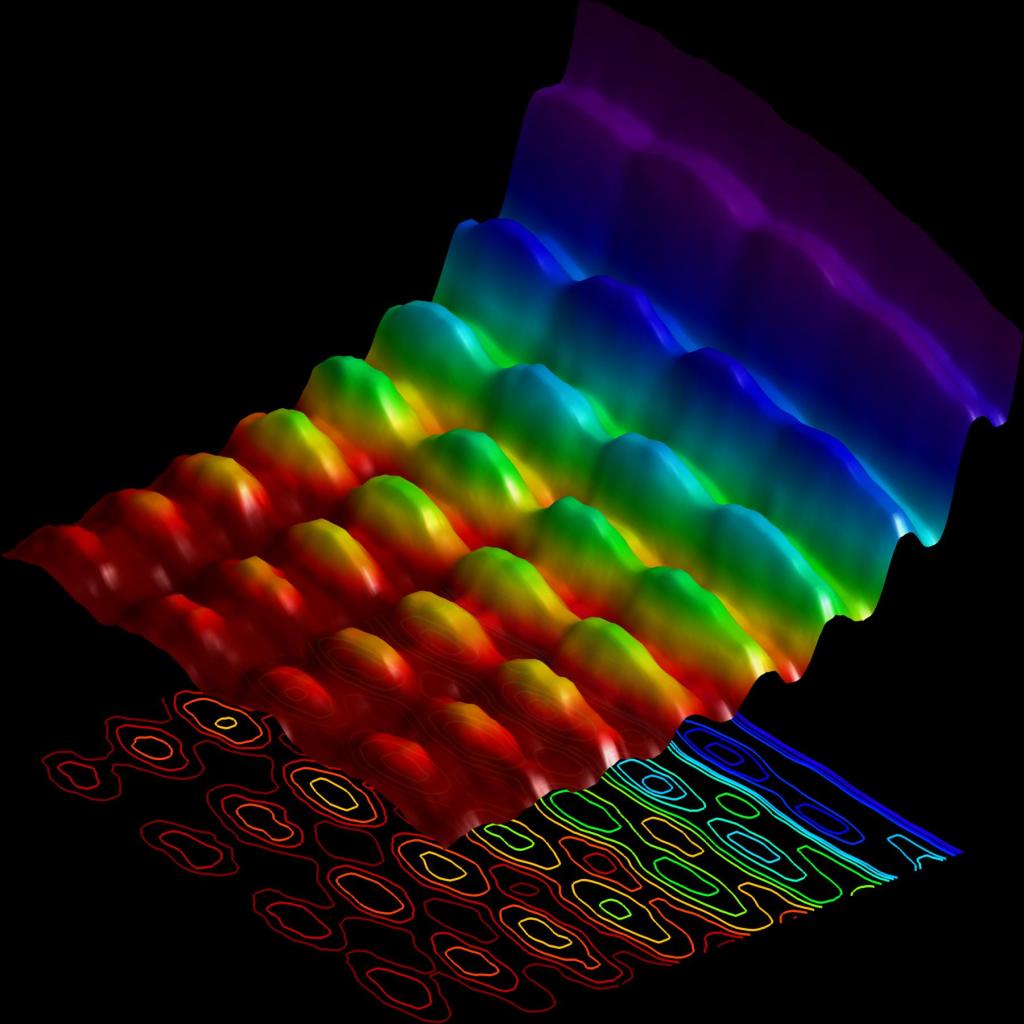
We are often told that electromagnetism is described by Maxwell’s equations—compact symbols that live comfortably on chalkboards. But what the 2015 image made impossible to ignore is that Maxwell’s equations are not simply mathematical abstractions; they are blueprints for geometry in motion. They describe a shape. A structure. A spatial logic. And for centuries, our geometry curriculum has not equipped students—or even many scientists—to see this.
EM Isn’t Just a Wave — It’s a Whole Geometry
We’re all taught that electromagnetism is a wave. Or that it’s a particle. Or that it’s a mysterious switch between the two. But the 2015 image shows something different: the wave-like pattern and the concentrated “particle-like” center are both part of the same structure.
It’s not switching back and forth. It’s one thing with multiple geometric features happening at once. That means EM isn’t a simple line, or a circle, or a Euclidean diagram. It’s a shape that bends, curves, concentrates, and radiates. In other words: the geometry is doing the work.
Three Geometries in the Same Picture
What makes the image so striking is that you can see different kinds of geometry overlapping:
- An object in the clean, repeating wave pattern
- Infinite Direction where wave continues on forever
- Finite Magnitude in the intensity
This is the point, ray, and vector of Euclid geometry found in the most absolute manner, at the center of the most important substance.
Why This Matters
The big takeaway is simple:
Electromagnetism isn’t just described by geometry. It is geometry.
Seeing the first real image of EM makes this obvious in a way equations alone never could.
This matters for how we teach science, how we visualize physical systems, and how we understand the natural world. Geometry isn’t just something you use to build a house or calculate an angle. It’s the language the universe uses to organize energy, information, and power.
And electromagnetism is one of its clearest examples.
Where This Leads
This is why I created my Geometric Primer for Electromagnetism—a way of teaching and visualizing EM that starts with shapes, not memorized formulas. When you look at the 2015 image through a geometric lens, suddenly the whole field starts to make sense:
- Waves and particles are geometric behaviors
- Fields are nested structures
- Space bends, flattens, and curves depending on energy
- Complex patterns become intuitive once you know which geometry you’re looking at
The geometry was always there. We’re just finally learning how to see it.
 A Sandy Foundation
Leave a comment