
Then, there was light.
Electromagnetism is a captivating enigma that has taken center stage for centuries. It is a substance that is fundamental but also, somehow lazy when no one is watching. When someone is watching, it acts like a wave. When no one is watching, it is a particle. So which was it, a particle or a wave? It wasn’t until researchers Piazza et al. (2015) captured the first-ever image of light that we confirmed that light was a wave-particle thingy. It was both.
As to why electromagnetism has this duality, it is not known, but it would be in line with a substance that is embedded with wave and particle logic.
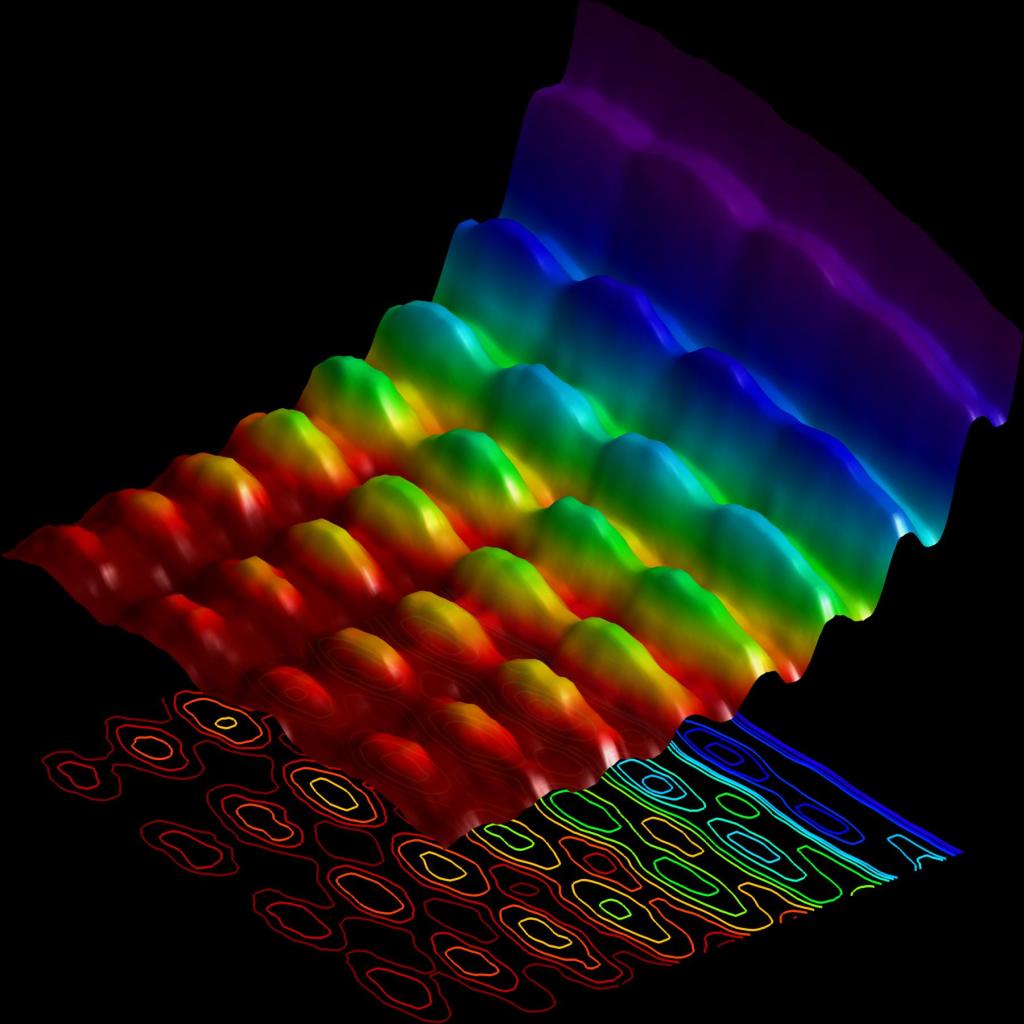
There is an online science news website called I Fucking Love Science, so again, I’m in my lane but I’m looking at this picture and I began seeing a complex system of points, rays, and vectors. Electromagnetism, to me, seemed to be following very strict rules of geometry but it was a fascinating to chase what seemed like nothing but a white rabbit down a hole. Okay, if electromagnetism was somehow strictly geometric, and I knew geometries could evolve, was there a “boot sequence” that could align with electromagnetism?
The first starting place was with Electromagnetism itself and almost immediately, Row 1 snapped into place as a readable program.
Here is the updated draft illustration:

From my original 18 Base geometries, I aligned just the first row with the image of the photon and the characteristics of electricity and magnetism that constitute electromagnetism.
I decided to colorize the flat, embedded objects because it helped to showcase the embedded nature of geometric evolution when energy is added into the system.
You may have notice that I made a change with the Row 1, Column 6 object between the original set and the updated version going with a flat oscillation instead of a closed proto-isohedron.
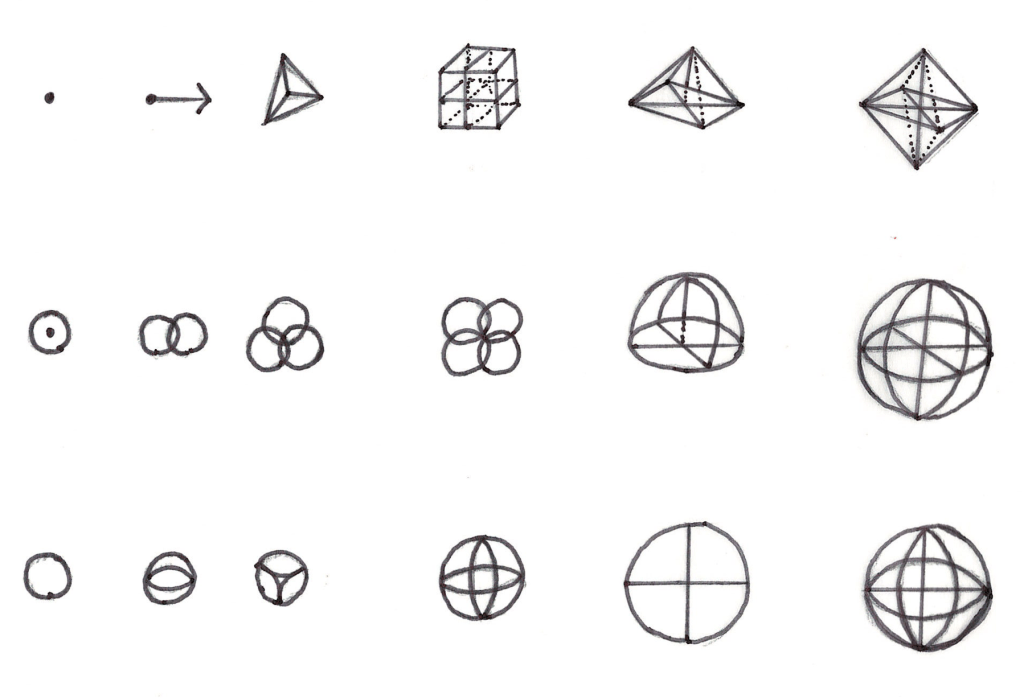
To initiate electromagnetism, the sequence unfolds with starting with (1) an electric charge, traversing through (2) an electric current, expanding into (3) an electric field capable of transforming into (4) magnetism, featuring (5) pole one and (6) pole two locked together, ultimately evolving into (7), a stabilized particle of Electromagnetism.
There is an another nomenclature that can be used for the geometries: (1) a simple object, exhibiting (2) external or simple movement, acquiring (3) simple magnitude that transforms into (4) a complex object, characterized by (5) complex internal motion tied with (6), a complex magnitude, a progression culminating in (7) a complex system that is stable and independent of a power source.
That first row might seem like just luck or a coincidence and admittedly, this doesn’t seem like a strong argument without additional evidence. So, let’s look at the additional evidence which would be solutions for objects that match the geometries of two more column 7 objects.
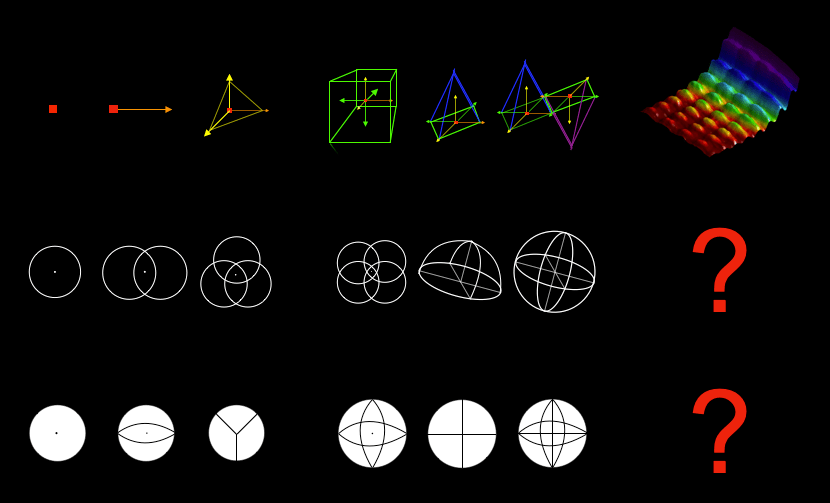
There are leaps of complexity between Columns 3 and 4 where something special is gained by the increased energy and it would be keeping in line with the visible pattern if a complexity event occurred a second time, giving a seventh column of objects with special characteristics. This might not seem like enough evidence to continue but it wasn’t the only clue that something interesting was happening. The very characteristics of light demand a major and minor version of itself, a thought that propels a simple seventh dimensional object from the top of elementary school social structure, into bottom social rung of secondary.
So far in recreating my geometric primer I have introduced only 19 of my 22 geometries; the final three were deduced by me. Only two are mentioned above so why a third? If folks are wanting to play the game of finding their own answers without being influenced by my work, this is a good time to take break. Otherwise, prepare ye all who enter here for wonders abound.
SPOILERS SPOILERS SPOILERS SPOILERS SPOILERS SPOILERS SPOILERS SPOILERS
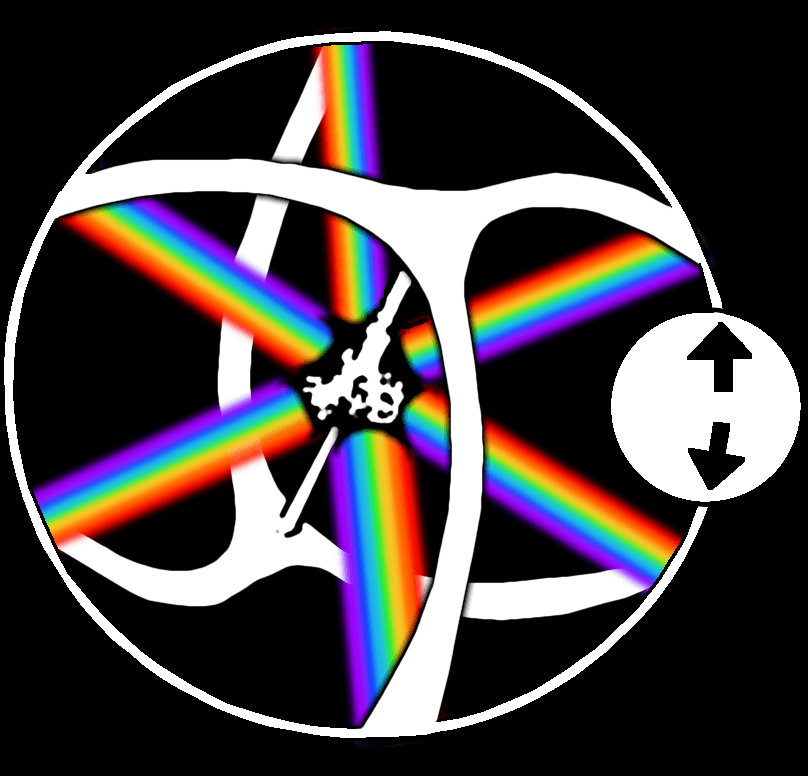
Two of the last three objects that I used should not surprise people as they are already known but do not exist in a purely geometric form. Those objects are a Black Hole and a White Hole built with six-embedded layers of geometry.

WHITE HOLE
A Black Hole to White Hole conversion is considered one of the possible ways a Big Bang starts a universe. They are very extreme objects in the universe which seemed to me like another exhibit of the geometric nature of our universe.
BLACK HOLE
Why are these objects correct? That is for study and comparison but for their simplicity, they hold a heavy amount of complexity. It takes time to studying but all of the underlying internal logic is present, plus additional attributes.
With geometric objects for a Black Hole and White Hole, this bring the total count up to 21 out of 22 objects needed. There doesn’t appear to be any more “holes” so what is missing to create a final primer?
The universe has this characteristic that might be called inverse and opposite, and it’s a way the universe naturally balances itself. Therefore, to balance the inverse nature of an evolutionary sequence for electromagnetism, I needed a geometric object that didn’t evolve and was opposite in nature. Light doesn’t just evolve, it also replicates, virally. This meant to me that I needed another geometric object to represent a super-flat realm, one where light didn’t evolve, was neither flat or curved but rather, hyperbolic. This single object would be the same no matter the size so I didn’t repeat it seven times. I didn’t want to change the names for the first three rows, so this new object was placed on Row 0 and my primer was finished.
With all the pieces, let us review all 22 pieces together.
 A Sandy Foundation