
Atom Savage
The previous two parts review how I achieved the collection and sequence of the 22 geometric objects outlined in my Geometric Primer (Illustration 1 of 2): 22 Unique Geometric Forms of Electromagnetism.
But Sandy, I don’t see a universe in here, not even the pieces to one – what’s going on here?

Great question imaginary person I hope one day reads this. This first illustration allows the viewer to see and follow the morphologies occurring in the geometries, especially along the evolutionary path. In this way, you just have to focus on the pattern, and not all the pieces. The particles and forces are very important. Why?
Researchers don’t know WHY particles exist the way they do; they can’t find a pattern! BILLIONS of dollars are spent on super colliders with the dreams being that they will pay off IF some new breakthrough will give them the Eureka! moment. It is conjectured that only with some grand picture of the universe, may science actually get started in earnest.
What is so confusing about the particles and forces? Let’s view a quick list before we start the alignment and review their place in a geometric recreation of the universe.
The photon or the boson for electromagnetism, has itself a virtual particle or smaller bit of itself that it can share. There is no antiparticle but there is an anti-logic boson, the Higgs which creates the super-flat realm needed for everything created by the photon (ie. everything in our visible universe). Electromagnetism has one boson. The Higgs has one boson. Don’t get to excited if you think you see a pattern because the Weak Force has three bosons. THREE!!
Why are there only three particles for the weak force? Like three in total including the anti-particle. Three: a positive, negative, and neutral. Okay, maybe the pattern will manifest with the next bosons, Leptons.
Not a chance. Leptons have charged and neutral particles which are completely different in design. Charged Leptons are shell clouds in three sizes, all with antiparticles. The neutral Lepton is a super-light-weight neutrino that changes flavors in flight. If we should count all the individual lepton names (types and flavors), there are numbers from 11-121. Neutrinos are bizarre particles that change states or flavors in transit at exact intervals, which, (here is the weird part) requires knowing the moment of their own demise the instant they are created. Electrons, the perfect shell for an atom, come with two bigger, almost bully-like brothers that essentially serve a function to destroy atoms. All these are Leptons and we haven’t gotten to the highlight of the subatomic realm, the strong force.
Gluons are the boson of the Strong Force and they suffer from co-dependency meaning it is only stable in gluon pairs and this is then called a Quark. The strong force is not a straight forward particle, it’s probability-based with a complex system to regulate it called Quantum Chromodynamics (QCD). That topic is a a rabbit that may be chased later but it is because of this QCD system that the strong force is able to do its own evolutionary mixing. While one pair of gluons, i.e a quark is stable, two quarks may mix, and can potentially evolve into three quark-pairs. It is these three quark combos that give us Baryon Energy i.e. protons and neutrons that are stable and the basis for the elements.
This evolution of the strong force comes with three additional forces that allows these combinations of protons and neutrons to further undergo fission, fusion, and beta-becay, thus further allowing an evolution into heavier and heavier elements. Heavier elements give rise to heavier planets, onwards and upwards until eventually, the band the Toadies bursts onto your speakers and you remember the rest of story while singing, “I come from the water.”
All dancing aside, we know so much about Photons, Higgs, Weak Force, Leptons, and Guons/Strong Force but still modern science still has so many questions. Nothing seems connected in a direct and self-evident manner… until now.
Alone, my first illustration with the 22 Geometries is a pretty picture but it’s value is hard to see. There is a lot to read in it but it doesn’t exactly show where a universe comes from, just what forms might take shape in that universe. For this reason, I created a second illustration to combine all the pieces into a single tapestry that shows the warp and weave, along with the threads.
This is another stopping point if someone wants to try their hand at assigning the subatomic particles and forces to my geometries. It wasn’t until I started playing with the subatomic particles and atomic forces, drawing out each individual one and listing their characteristics, that I started to see how to put them together. I also followed the logic within the geometries, looking for points, rays, and fields – which they have in common.
SPOILERS SPOILERS SPOILERS SPOILERS SPOILERS SPOILERS SPOILERS SPOILERS SPOILERS SPOILERS
The second illustration has a lot going on so let’s look at the sections first.
The top right has the title for the whole piece; the main object in the center is an analytical key with various objects coming off. This is the actual boot sequence.
The bottom left contains The Mixing Key: Four Easy Pieces, a two-part program that controls how each layer is mixed. An analytical key doesn’t have any brains to it and needs a reason for each discontinuity. Thus, a control logic was needed.
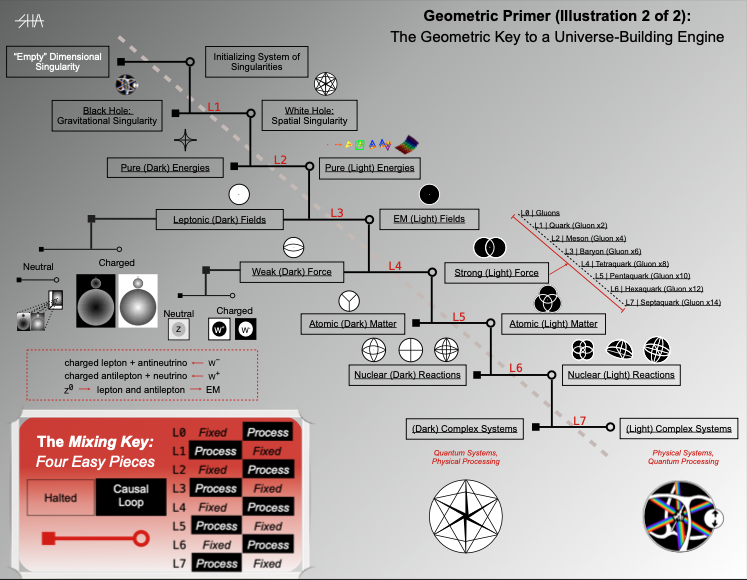
The control logic was added to capture the effects of extremes used in stopping and starting computer logic and was inspired by Issac Asimov. The major versions of Halted and Causal Loop remain fixed along the key; the minor variations of fixed and process swap places at each change in level. The mixing key helps separate and categorize the characteristics of the universe by keeping them organized using very strict, but similar control logic.
There is a duplication within the full sequence and this is seen as a positive reenforcement of its continuation. Looking first at L1, this level has a Black Hole on the left side as a Halted/Process which aligns with a Black Hole at the end of its creation contribution. The Black Hole reappears on the right side of L7 as a Casual Loop/fixed where it the Black Hole is shown in its creation with the potential to one day become large enough to spawn a universe of its own. This complete Life Cycle of the Universe is what has been missing from the story of the Big Bang; it was implied but not so explicitly shown together.
The Big Bang Theory isn’t just about how the universe began—it shows how space, time, and energy all burst out from a singular origin. To explain how this could even be, physicists point to the geometry of black holes and their theoretical opposites, white holes. A black hole is where matter collapses inward making a singularity, while a white hole is imagined as both the torus gate (a singularity) it passes through and the act of matter and energy bursting outward (yet, another singularity). In this sense, the Big Bang itself can be thought of as a process made possible because of the potential of an initializing system of singularities. Where does this ultimate release-point from our universe emerge? Is there another singularity out there? My theory and the geometry signals an empty dimension.
Once I get the acceptance for the Black Hole and White Hole onto the stage, the geometry takes over and the logical organization makes it easier to fill in the gaps. I also relied on the already highly-researched understanding of the cosmology of the universe. As the geometries aligned, they seemed to all fit inside a single, eight-step analytical key.
There is a specific naming used on the illustration to divide the different sides of the key which came about because of words used often in science; it’s alignment with the concepts of dividing the light and the darkness was an accident which I embraced.
Here is a formal breakdown of the Levels.
LEVEL 0 – Emptiness
LEVEL 0 – L0 isn’t labeled but it’s similar to a zero dimension of probability and possibility of the Initializing System of Singularities.
LEVEL 1 – Singularities
LEVEL 1 – L1 would be very strict 1-dimensional objects that we even respect with the name singularities. The Black Hole and White Hole are already known and used in this context; we still need to reverse engineer their own logic so we simply cannot stop here.
LEVEL 2 – Pure Energies
LEVEL 2 – L2 is external motion with the label of Pure Energies which consists of all the material inside the Black Hole being released. This aligns with the external motion of the Column 2 objects within my Geometric Primer. For the particles, the left side holds the Higgs Boson, doing its thing by being the scalar backbone of the photon. On the right, is the Pure Light Energy of the photon, also known as Pure Gamma Radiation filling the universe with enough potential energy to evolve baryonic energy.
LEVEL 3 – Subatomic Fields
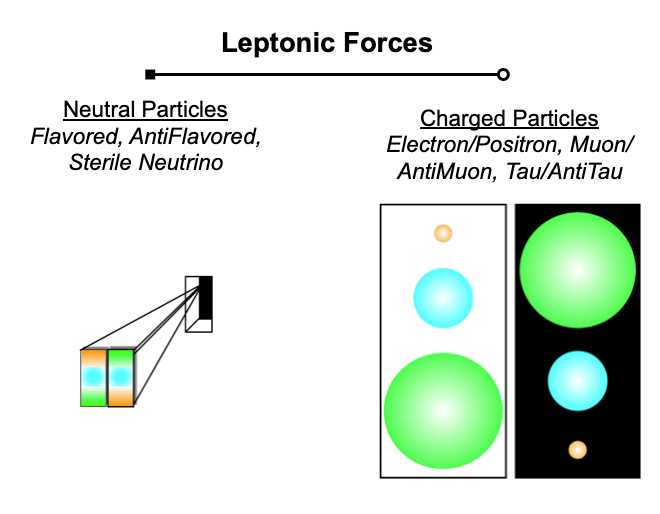
LEVEL 3 – L3 is for simple, yet Pure fields which include the family of Leptons on the left or dark side and the virtual photon as the Electromagnetic particle on the right. There is already well established geometric words use to described Leptons and Photons and these are used as contributing characteristics for this classification.
Charged leptons are (A) point-energies that exist by (B) moving within a (C) spherical ‘shell’ or field based on statistics.
Neutrinos are (A) point-like particles acting as (C) fields as they (B) travel in oscillating waves through space.
My geometries are there plainly; and the logic embedded in the geometries is there, just mixed up!
LEVEL 4 – Nuclear Forces
LEVEL 4 – L4 is going to be for objects that have gone through a morphological change into a force and are now slightly more complex. The left side holds the Weak or “Dark” Force while the right side has the Strong or “Light” Force. The visual logic of the geometries is again helpful for the alignment.
For the Weak Force, the “dark” geometric object holds the more flat geometric object with exactly three parts. According to the mixing key, it is also Halted and Fixed and based on what researchers already know about it:
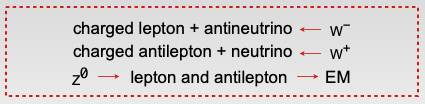
The Weak Force is a byproduct of a process and is directly connected to other reactions in a passive manner. A Halted/Fixed logic is plenty enough for that.

Another important note from this insight is that there is nothing happening on the “Dark” side that isn’t happening to the entire dark-side, all at once. This is unlike the “Light” side which requires so much additional energy, time, and space but only after it is at it’s full potential is reached mechanically. Let’s look at the “light” side and the strong force.

We know from previous conversations that a gluon is only stable in pairs so the geometry on L4 being two circles is appropriate. It is different amounts of Quarks that evolve up and I added those known options.

Gluons have this “coloring” which any flavor of Quark can exhibit. In total, there are six stable gluon pairs and two that are unstable, considered colorless, and allow for overall gluon-mixing.

Quarks only have a fractional charge, either positive or negative 1/3 or 2/3. It is because of this ratio and the underlying color balance within three quarks that baryonic particles or atomic matter is even possible. Three quark pairs have other names including Baryons and include the protons and neutrons of atomic matter. A single proton, for instance, is also a Hydrogen atom and the precursor to stars.
LEVEL 5 – Atomic Matter
Level 5 – L5 represents an evolution into matter. The right side probably makes sense as the strong forces evolves atomic matter. It is made from Light, so I called it Light Matter. This isn’t the hard part. It is going to be the left side of the analytical key, that folks raises an eyebrow because across from “Light” Matter, is of course “Dark” Matter.

Is this truly the same Dark Matter, as in the majority of the universe, Dark Matter? Yes, the one and only, but the researched object that most aligns is called Dark Fluid.
The geometry is also a clue into what is happening at this stage because it’s what the geometry of renormalization actually looks like. Renormalization is this process where you take a messy formula or process and make it “normal” again by taking all the wild parts out and placing them off to the side. The lost infinites from what, you might ask? The gluon-exchange that is manifesting baryons. Placing them where? Into the container that is Dark Fluid.

Seems like a literal geometric interpretation of a process and I would say, exactly! That is the evidence that points to a very geometric universe. This would explain why jets spray out of single gluons when you smash them – where are they hiding all of those gluons? What if even the universe figured out pockets!
LEVEL 6 – Atomic Reactions
LEVEL 5 – L5 consists of Atomic Reactions, with both Light and Dark versions and are already known. The known light reactions are Fusion, Fission, and Radioactive Decay. There are three kinds of radioactive decay: Alpha decay caused by the Strong Nuclear Force, Beta Decay caused by the Weak Nuclear Force, and Gamma Decay is caused by electromagnetism.

Geometric representation for Fission, the breaking apart of atomic structure, releasing energy and radiation harmful for organic life.

Geometric representation of a Beta-Decay or the half-life of particles. There are two other decay processes: Alpha and Gamma.

Geometric representation of fusion, or the coming together of particles to make a new whole.
These forces allow for the further evolution of matter into more heavy elements, all the way up to the iron needed for habital planet cores. Iron is atomic element 26 and reading down from the list is almost like reading a vitamin bottle for humans.
Nuclear fusion is a process of binding nuclei together which releases less and less energy until an element becomes endothermic as Iron does. Muon’s come into play with fusion with Muon-Catalyzed Fusion which is thought to facilitate the process by lowering the temperature needed for fusion reactions to occur.
Nuclear Fission releases more energy than fusion that are radioactive for much longer periods of time. There are seven long-lived fission products that last longer than 200,000 years and the resulting nuclear waste from power plants has become a monumental clean up task for humans on our planet.

Nuclear “Dark” Reactions are speculative as a title but do exist as phenomenon in our universe. They are Dark Energy, Dark Matter/Dark Fluid, and their effects being increased curvature in the visible universe.

Dark Energy which exerts a negative pressure on the universe, accelerating expansion post the Big Bang on super large objects.

Gravity or the inward attraction caused by the collection of dark matter/dark fluid.

Together, Dark Energy and and Gravity are flat geometries that give curvature to objects in our universe.
LEVEL 7 – Complex Systems
LEVEL 7 – L7 is the final level and contains the complex systems showing the logic for a Black Hole and a While Hole.

Just like there are many different kinds of quarks and elements, there are a few complex systems that use these logic designs, one of them is humans.
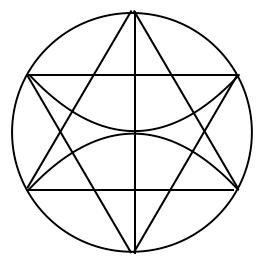
While called ‘Dark Complex Systems,’ this halted/process is simply an access point or gateway like a White Hole.
The Light Complex System can be a Black Hole, but also this could be any planet. The logic can also be aligned with might be called a Human Complex System, opening the world up to the potential for a new answer to what it means to be human.

Summary
Pat yourself on the back, you made it to the end. If accepted, the geometric primer would revolutionize the world of science. It could also change how we see humans, the basis for which is currently mostly decided by traditions over modern science.
So, what’s next?
That is up to you.
The geometric primer still needs to be studied. In order to get published, it has to get academic endorsements but getting this work in front of the accredited peers is a huge barriers. Even if I were able to afford to pay the fees to attend a math conference, there are expenses associated with attendance. Working on a book is another option but takes time and money. I am currently focused on building a community of interested people
- A 12th Neutrino is the Sterile Neutrino. ↩︎
 A Sandy Foundation