
-S@
Based on the work by Dr. Lisa Feldman Barrett that is captured in her book:
HOW EMOTIONS ARE MADE (2017).
Where do emotions come from?
Emotion words like Love, Hate, Anger, Sadness are all familiar to most people but what is their foundation in science? In the 1960s, Dr. Paul Ekman codified many of our current beliefs for that time, a program that would eventually be placed in preschool education systems by the 1970s.
Modern science has countered these previously accepted ideas that included concepts like recognizing emotions in faces and the general idea of pre-born emotions with triggers. With the advancement of technology, neurological studies using MRIs tried to pin-point these triggers but they were never found [Barrett, 2007].
If people are not born with emotions then where do they come from? Well, it makes sense that they are cultivated, grown, and evolved. This is a massive shift in logic. These implications are far reaching because something that is programmed once, is programmable again. Emotions can change. What are the impacts? The US prison system is philosophical aligned with the Classical Emotion Theory which disregards the very concept of rehabilitation as a medical impossibility.
Dr. Feldmans book HOW EMOTIONS ARE MADE is review of the modern research and experiments that explore into the categorization of the parts of the human experience that participate in the process of emotion making. Once reviewed, you will be prepared to take the next step in mapping out your own cognitive reality with an interactive Emotions Mapping exercise I designed.
The spectrum shown below visualizes what Barrett referred to as (1) an instance of emotion [GREEN}, wherein one of two tools of the brain will activate that either (2) evolve [BLUE] or (3) de-evolve [YELLOW] the cognitive reality. These words are a little sterile for the human experience.
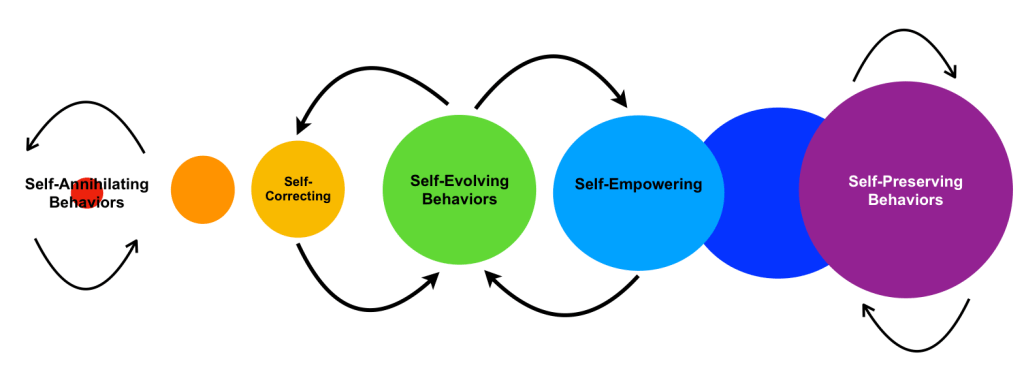
Another way of rendering this spectrum of cognitive realities is to align the definitions of the experiences of (1), (2), and (3) with words used in personal development and human behaviors. That adjustment is expressed in the words used in the illustration below.
2) An instance of emotion may under go “Self-Correcting,” as needed. If this tool is abused, self-correction turns into “Self-Annihilating Behaviors.”
1.) The Instance of Emotion in this illustration manifests from and includes the established set of “Self-Evolving Behaviors.” This represents both an instance of emotion and the set of established responses from ongoing self-evolution.
3.) An instance of emotion may undergo “Self-Empowering,” as needed. If this tool is abused, self-empowerment turns into “Self-Preserving Behaviors.”
BUT WAIT!!! There’s more!
While working on this model, I was also in procession of a copy of Tema Okun’s White Supremacy Culture. This document is making its way around some elite DEI circles but I had a Eureka moment because her 15 behaviors fit perfectly in one column. Can you guess which?
SPOILERS: Okun’s list of behaviors were found in two informal studies to align with the concept of Self-Preserving Behaviors.
With Okun’s list of words as a starting point for Self-Preserving Behaviors, we can have a more guided conversation and co-develop a list of behaviors that match our modern day reality and culture. For my two informal group studies with peers, the illustrations below capture our rendering of Horizontal and Vertical Behavior Models:
Going back to basic Emotion Theory and Dr. Barrett’s work, I have also designed a tool for individual Emotions Mapping.
Ze is taking on new conversations. If you have any science, universal-mystery questions or want to say hi, please get in touch zer.
Zer Blog
What the First Image of Electromagnetism Reveals About Hidden Geometries
In 2015, a team of researchers led by Fabrizio Pizzazz and colleagues captured what is now considered the first direct visual image of an electromagnetic field. For many people, the image looked like a shimmering wave—an elegant interference pattern or a cloud of ripples frozen in time. But for those studying the geometric foundations of…

Where’s the Geometry? A Missing Link in the Foundations of Mathematics” Response to Quanta Magazine’s Article | Is Mathematics Mostly Chaos or Mostly Order? (Answer: A simple and Comprehensive Geometric Primer for Electromagnetism in Two Illustrations.)
Original Quanta Article Response to Quanta Article
 A Sandy Foundation