
-S@
Artist Notes and Points
Sandy Flowers is NOT a licensed councilor NOR a mental health practitioner of any kind. There is no claim of that anywhere and ze asks that it not be projected onto zer work combining art and science. Ze is also not a guru or magician. To the best of zer ability, all work is shown. Do you see research results, graphs, etc? No? That’s because this work is pending initial testing. Part of the process of exploring new ideas is waiting for peer review and grounding. Namaste.
- This work does not reflect the opinion of Dr. Barrett (goals).
- These templates are not meant to replace therapy nor do they represent the totality of Emotions or Cognitive Realities.
- There is more than one way to fill out the templates as the parts are adjustable.
- When finished, YOUR Emotions Map becomes a simple visual snapshot of yourself in time and space; as emotions are subject to change over time, remember that your Map is also subject to change.
- Not every culture or society values a diversity of emotions, thus making this whole process moot. I’m zen with this.
- This is a novel activity that may be used to help a person develop words to describe their inner reality.
- A couple or family may share or co-create an emotions map which doesn’t replace their solo map. Rather, it helps translate between the two maps.
- No one has to share their map and on the flip side, don’t force your sharing.
- Talking with your community about emotional expectations is important but not always available or suitable.
The Essential parts of an Emotions Matrix: Building the frame.
FIRST, we need the categories of sensations from Dr. Lisa Feldman Barrett’s 2017 book HOW EMOTIONS ARE MADE. This book outlines the history, science, and modern research behind the theories of emotions and outlines characteristics related to Constructed Emotion Theory. There is a lot to unpack in this book but here’s a quote to help:
“I explain that each time you experience emotion or perceive it in others, you are again categorizing with concepts, making meaning of sensations from interception and the five senses. This is a key theme of the theory of constructed emotion.
(HEAM, 2018e, p86)
Here are the four categories of sensations:
Pleasant
Unpleasant
Arousal
Calm
SECOND, we need to cross these sensation categories (Pleasant, Unpleasant, Arousal, and Calm) with experiential categories that give us narrated environments to react with. This process is accomplished using universal questions all humans ask and answer differently to themselves to clarify their own reality. More on WHY these questions is listed further below.
These six query-style questions help get us started:
What is real?
How do I behave?
What does this mean?
What do I believe?
What do I want?
How do I feel?
And one binary-checksum question that is impacted by the emotion categories helps to wrap up the set:
Am I being true to my collection of decisions?

Let’s review what we have so far.
4 Sensations x 7 Experiential Questions = 28 Sets of
Cognitive Realities
So far, this process would give us 28 emotion words, which is a good start but we can dive deeper into the science of Created-Emotion Theory for even more insight and more words.
According to the research of Barrett, we don’t just experience a simple chemical sensation from an on/off toggle switch as described by Ekman. There is a lot going on inside a human mind with emotions including what is called an:
“INSTANCE OF EMOTION.”
(2018e, p36)
“I explain that each time you experience emotion or perceive it in others, you are again categorizing with concepts, making meaning of sensations from interception and the five senses. This is a key theme of the theory of constructed emotion.
(2018e, p86)
That may or may not be the end of that instance as overtime, the mind was shown to evolve or devolve that experience. This is similar to the difference between an instance of weather and the overall climate. Therefore, these 28 sets of cognitive realities will need to reflect this climatic spectrum.
All of these moving parts might imply that creating any emotions map is complex but with rules similar to those found in poetry, the end results below are similar to the famous MAD LIBS fill-in-the-blank games. Just fill in the answers below with how you would respond. The human brain learns to make predictions and this is just another one.
The five internal parts in each Matrix Block.
Experiential Question:
The Ego
What is REAL to you…
Sensation Reaction:
Pleasant
is reciprocated by others…
Defining:
An Instance of Emotion
and what starts out as ____________________…
(validation?)
Spectrum Extreme 1:
Evolved
may evolve into ____________________…
(empowerment?)
Spectrum Extreme 2:
De-evolved
or de-evolve into ____________________.
(narcissism?)
Each segment of the SET is easily adjustable and the first two sections are there to help link responses to various predictions. That’s the insight about Constructed Emotion Theory and one of the ways it turns the Classical Model on its head.
Experiential Questions
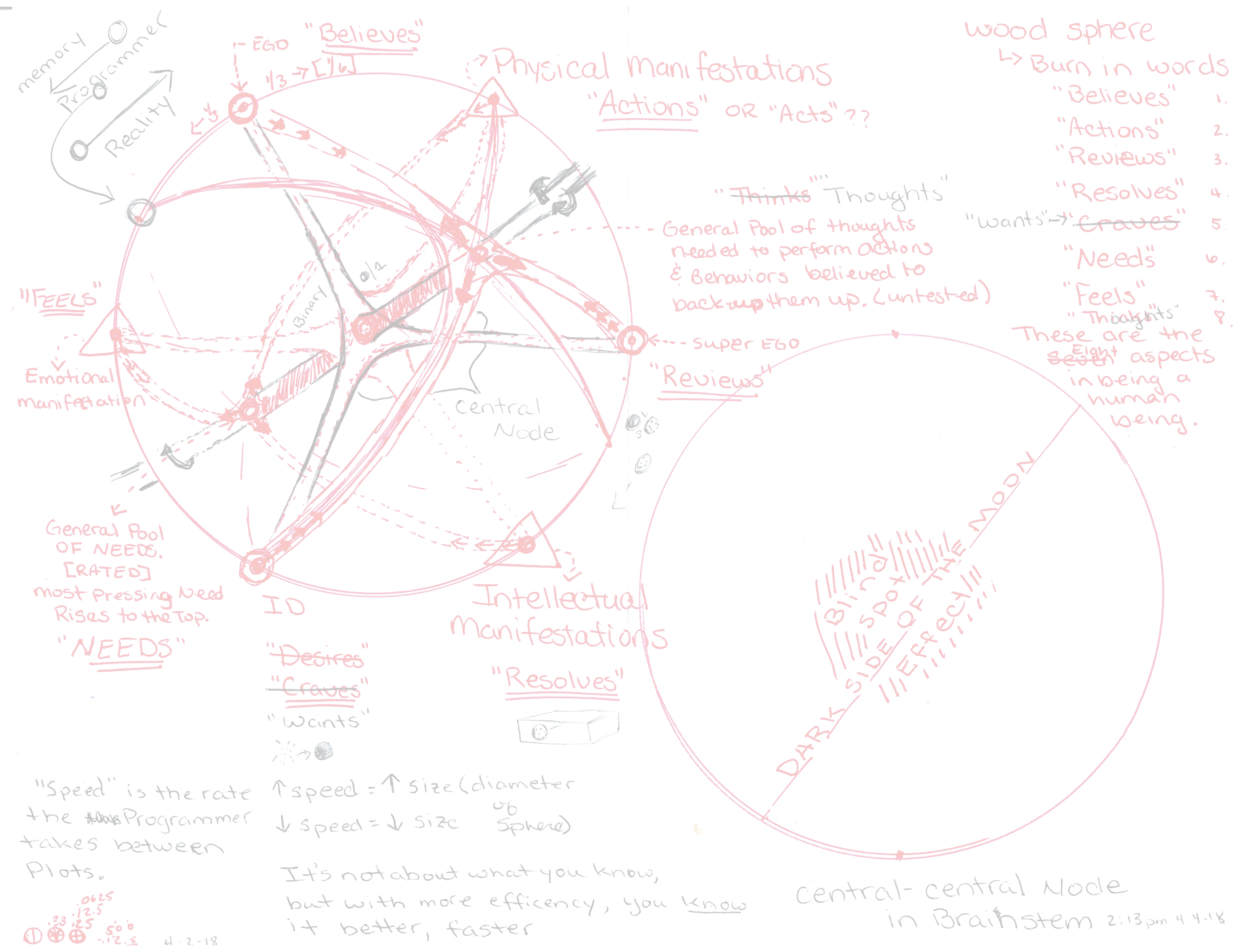
The 7 Experiential Questions were inspired by a simple concept called Embedded Systems Theory and the less simple concept of geometric visualization of logic (ie. Euclid). Embedded Systems Theory, as applied to a Human System, might look like the Figure 1. As with all systems, each dimension has its own reality and purpose to fulfill while still performing in a way that supports the rest of the layers. Computers use embedded layers in a similar way and their seven layers match the logic stack of the Human System, simply inverted.
Figure 2. Visualization of the logic stack for computers based around the TCP/OSI model.
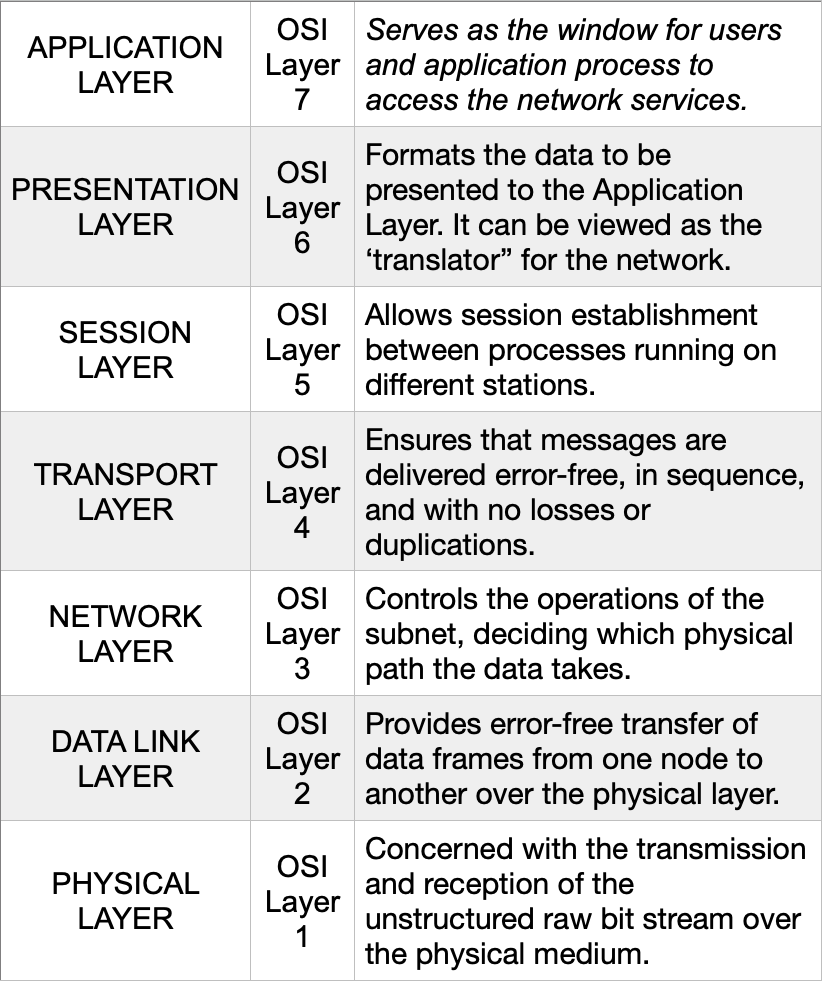
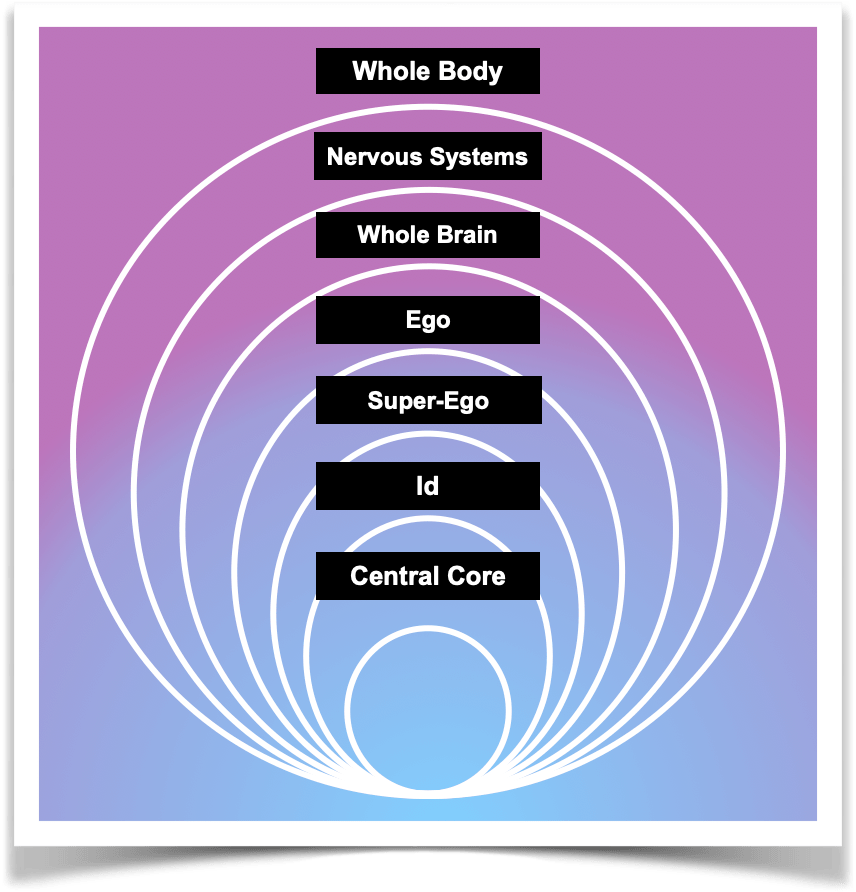
Something computers are good at doing is retrieving questions from a database and Sandy Flowers set out years ago to find good questions that would allow Human logic to move through the layers. Referencing Figure 1, the experiential questions model the logic stack as a person moves deeper inside themselves.
The Whole Body is answering the question: How do I behave?
The two Nervous Systems are answering the question: How do I feel?
The Brain is answering the question: What do I believe?
The Ego is answering the question: What is real?
The Super-Ego is answering the question: What does this mean?
The Id is answering the question: What do I want?
The Central Core is answering the question: Am I being true?
The experiential questions may be modified to meet updated interpretations of these subsystems.
Design Limits
What are the current known limits to this design model?
- Offering a framework might be restricting to people and require facilitators to change how different cultures are presented the materials.
- There is an entire spectrum between the extremes for additional emotion words.
- This idea is unpublished as of yet and lacking endorsements.
Blank Template for building Emotions Map
Finished Template of an Emotions Map
It’s over!!!
Thank you for reading.
Ze is taking on new conversations. If you have any science, universal-mystery questions to be illustrated or just want to say hi, please get in touch with zer.
Zer Blog
What the First Image of Electromagnetism Reveals About Hidden Geometries
In 2015, a team of researchers led by Fabrizio Pizzazz and colleagues captured what is now considered the first direct visual image of an electromagnetic field. For many people, the image looked like a shimmering wave—an elegant interference pattern or a cloud of ripples frozen in time. But for those studying the geometric foundations of…

Where’s the Geometry? A Missing Link in the Foundations of Mathematics” Response to Quanta Magazine’s Article | Is Mathematics Mostly Chaos or Mostly Order? (Answer: A simple and Comprehensive Geometric Primer for Electromagnetism in Two Illustrations.)
Original Quanta Article Response to Quanta Article
 A Sandy Foundation